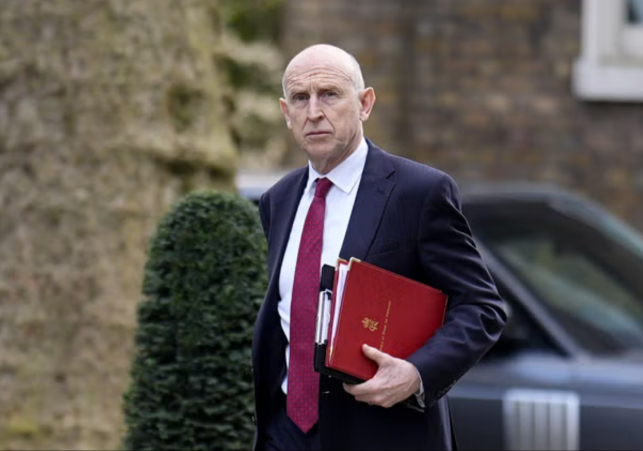
John Healey declines to rule out UK aircraft taking part in Iran strikes
- By --
- Saturday, 07 Mar, 2026
John Healey declines to rule out UK aircraft taking part in Iran strikes
UK Defence Secretary John Healey has declined to rule out British aircraft taking part in military strikes against Iran, as the conflict in the Middle East continues to intensify and pressure grows on the government to clarify how far the United Kingdom is willing to go in supporting allied operations.
Speaking during a visit to the British air base at RAF Akrotiri in Cyprus, Healey was asked directly whether he could guarantee that UK fighter jets would not take part in offensive action against Iranian targets. He refused to give a clear no, saying that decisions in a conflict must remain flexible as the situation develops.
Healey said the government’s current actions are defensive, but added that military planning must be able to change quickly if threats increase.
“As circumstances in any conflict change, you’ve got to be willing to adapt the action you take,” he said, while outlining steps already taken to strengthen British forces in the region.
UK increasing military presence in the region
The defence secretary confirmed that the UK has already sent additional equipment and personnel to the Middle East following recent drone and missile attacks linked to Iran. These measures include anti-drone helicopters, extra air-defence troops, and the planned deployment of the Type-45 destroyer HMS Dragon to the eastern Mediterranean.
More than 400 extra personnel have been sent to Cyprus to reinforce protection around British bases, particularly after a drone strike hit RAF Akrotiri earlier in the week. Officials said the move was necessary to ensure the safety of UK forces and allies as the conflict spreads across the region.
Military planners are also working with NATO partners and other allied countries to coordinate responses, with ships and aircraft from several nations now operating in the area. Healey said cooperation with allies is essential as the situation becomes more unpredictable.
Pressure on government over possible involvement
Healey’s refusal to rule out airstrikes has led to questions about whether Britain could become directly involved in attacks on Iran if the conflict continues to escalate. Critics have asked the government to explain what conditions would have to be met before UK forces take part in offensive operations.
Ministers insist that all current activity is legal, defensive, and focused on protecting British citizens, military personnel, and regional allies. However, they have avoided giving firm limits on future action, saying the government must keep all options open while the war continues.
Tensions rising after attacks on UK bases
The comments came after reports of Iranian-linked missiles and drones being fired across the region, including incidents close to British military facilities. The attacks have raised fears that UK bases could be targeted again, increasing the risk that British forces might be drawn further into the conflict.
Officials say the government’s priority remains the safety of UK personnel, but they also acknowledge that the fast-moving situation means military decisions may have to change quickly if the threat grows.
With fighting continuing across several countries and allies increasing their military deployments, Healey’s remarks suggest that Britain has not ruled out a more direct role if the conflict reaches a new and more dangerous stage.
Related News
.jpg)